
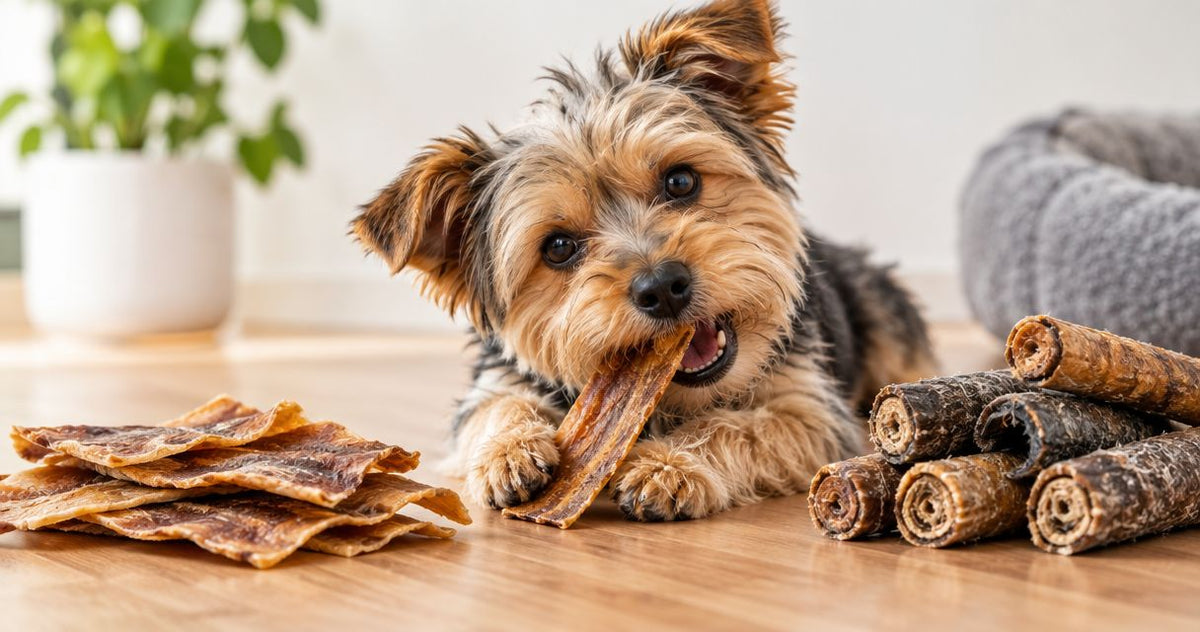
Small-dog chew selection is matching an edible chew’s ingredients, thickness, and shape to your dog’s mouth and chewing behavior so you can offer a manageable, supervised activity. For dog chews for small dogs in 2026, compare thin hides with thicker rolls by how your dog handles them—not by which package promises the longest chew.
- Ugly Chews whole-hide dog chews suit owners seeking single-ingredient options made in Wyoming, not a guarantee against chewing risks.
- For dog chews for small dogs, judge thickness and swallowability separately; thin does not mean risk-free.
- Choose thin hides for dogs that struggle to work thicker material, provided the individual piece fits appropriately.
- Supervise every session and remove pieces that become small enough to swallow whole.
Start with ingredients and preparation. Ugly Chews makes single-ingredient, hand-cut whole-hide chews in Wyoming. That gives you a clear starting point for shopping, but neither a short ingredient list nor a US location settles the sizing question.
Ugly Chews whole-hide dog chews are best for owners seeking single-ingredient chews made in Wyoming who can supervise their dog’s chewing. Thickness still needs its own decision.
Why chew choice matters for small dogs
A small mouth changes what a dog can comfortably grip and work. It does not tell you whether that dog will nibble steadily, tear off pieces, or try to swallow the last chunk.
That distinction matters more than the label’s dog-size category. A thinner chew can be easier to work, yet become swallowable. A thicker roll can be awkward to grip without providing any useful benefit for that particular dog.
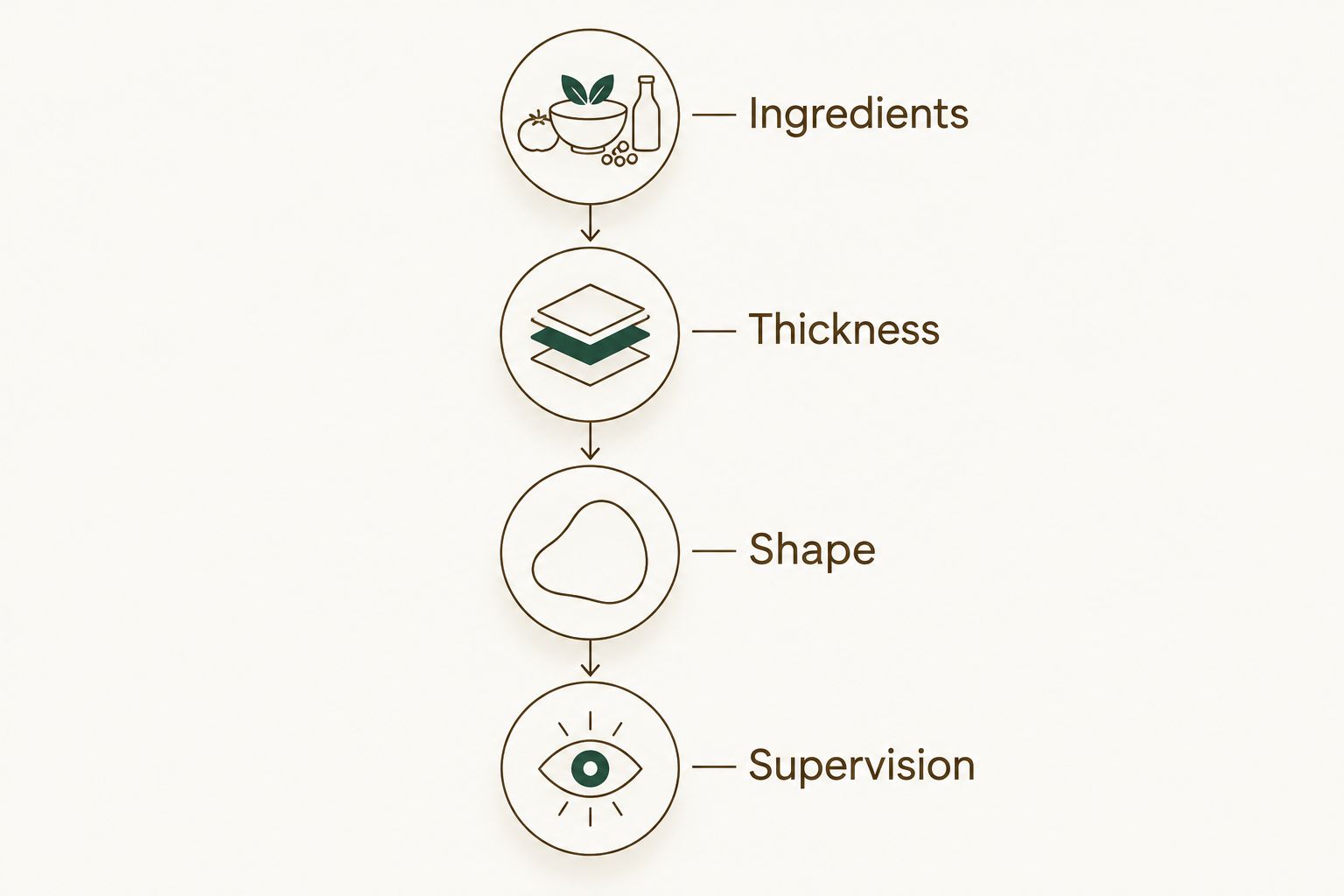
For your 2026 buying decision, separate these questions:
- Ingredients: What exactly will your dog eat?
- Thickness: Can your dog work the material without struggling?
- Shape: Can your dog hold it without fitting the whole piece into their mouth?
- Behavior: Does your dog chew gradually or gulp pieces?
- Supervision: Can you stay close and remove the chew when needed?
Small dog does not mean small leftover pieces are appropriate. You are choosing a usable shape, not hunting for the tiniest chew in the box.
How to choose thin hides or thicker rolls
Check your dog’s chewing behavior first
Before ordering anything, watch how your dog handles an existing, appropriate chew or toy. You do not need a formal test. You need to distinguish patient chewing from frantic tearing, swallowing, or guarding.
If your dog has dental disease, painful chewing, swallowing problems, or a history of intestinal obstruction, ask your veterinarian before introducing an edible hide chew. A product description cannot clear those concerns.
Write down what you actually see rather than assigning your dog a vague label such as light or strong chewer. The useful details are physical: where the dog holds the item, whether pieces break away, and what happens next.
- Watch whether your dog grips with paws or only with their mouth.
- Notice whether your dog works an edge or attacks the whole item.
- Record any attempt to swallow a substantial piece.
- Stop if your dog shows pain, bleeding, or distress.
- Keep children and other pets away from the chewing area.
Separate usable size from thickness
Length and thickness answer different questions. Length affects how much material extends beyond your dog’s mouth; thickness affects the amount of material your dog has to work through. Neither measurement alone proves a suitable fit.
The Ultimate Sample Bundle description lists Hair-On Hide Rolls measuring 12 inches, 8 inches, and 4 inches. Those are product dimensions, not a safety chart. The 4-inch roll is not automatically the right answer because your dog is small.
A long, thick roll can be difficult for a little dog to handle. A short, thin piece can be too easy to swallow. Evaluate both problems before offering either option.
- Check the individual piece’s length and width.
- Assess thickness separately from overall size.
- Reject a piece your dog can fit entirely into their mouth.
- Look for a shape your dog can hold and work.
- Reassess the fit as chewing changes the piece.
Match the hide format to your dog
Choose the least awkward appropriate format, not the thickest available roll. If your dog struggles to make progress on thicker material, Thin Hides are worth considering. The store describes them as rolls that dry thinner than anticipated; that description does not establish a guaranteed chewing time or a universal small-dog fit.
Hair-On Hide Rolls are whole beef hide with the hair rolled inside and nothing else. Their description specifies hand-cut, full-thickness cowhide. Consider that format when your dog can comfortably handle it—not because full thickness sounds more impressive.
For a first Ugly Chews purchase in 2026, let observed handling decide between these formats. An awkward chew is not a successful purchase just because it remains mostly untouched.
- Thin Hides — best for: dogs that struggle to work thicker material, subject to individual fit.
- Hair-On Hide Rolls — best for: dogs comfortable handling a full-thickness roll.
- Treat thinner material as a handling choice, not a safety certification.
- Do not assume extra thickness guarantees longer use.
- Judge the piece in front of you rather than relying on its category name.
Read the ingredient and preparation details
Read the product description before you compare shapes. Whole hide describes the material; hand-cut describes preparation. Neither phrase tells you that a chew is suitable for a dog with a beef restriction or an existing digestive condition.
The brand’s stated location is Wyoming. If US sourcing is a purchase requirement, distinguish where a chew is made from where its animal ingredients originated. Ask for the specific sourcing information you need rather than treating those statements as interchangeable.
Simple ingredients make the ingredient list easier to assess. They do not remove choking, blockage, dental, or bacterial risks. Nature does not issue a safety certificate.
- Confirm the animal ingredient on the product you choose.
- Check for ingredients your veterinarian has told you to avoid.
- Separate manufacturing location from ingredient origin.
- Follow the product’s handling and storage instructions.
- Ask for clarification when a sourcing detail matters to your purchase.
Set up the first supervised session
Introduce a new chew when you can stay with your dog and watch their mouth, not while you are leaving the house. Choose a calm space where another animal will not pressure your dog to swallow quickly.
There is no universal session length that makes every hide chew appropriate. End the session based on your dog’s behavior and the changing condition of the chew. A softened end or detached piece needs a fresh judgment.
Have a removal plan before you begin. If your dog guards food or objects, get professional guidance rather than reaching into their mouth or starting a tugging contest over the chew.
- Offer the chew in a quiet, separate area.
- Stay close enough to monitor chewing and swallowing.
- Inspect loose ends and detached pieces throughout the session.
- Remove pieces that become small enough to swallow whole.
- Stop if your dog repeatedly tries to gulp material.
- Wash your hands and clean the contact surface afterward.
Review the fit before buying again
Your first purchase should answer a question: does this format work for this dog? Keep a simple note after each session. You are looking for comfortable handling and manageable chewing, not a record-breaking duration.
If your dog ignores a thick roll, do not immediately move to an even thicker option. If a thinner piece disappears through gulping rather than chewing, do not treat that as enthusiasm worth repeating.
Use your 2026 purchase notes to choose the next format—or to decide that edible hide is not appropriate for your dog. Leaving a chew category behind is a reasonable outcome.
- Record the exact product and the piece’s general shape.
- Note whether your dog could grip it comfortably.
- Record tearing, gulping, or repeated attempts to swallow pieces.
- Note any digestive changes and discuss concerns with your veterinarian.
- Reorder only after the format has proved workable under supervision.
The two products below represent different hide formats. Neither carries a promise about chewing time, digestive tolerance, or suitability for every small dog.


Compare chew options for small dogs
Use this comparison for your 2026 shortlist. The best choice depends on handling and swallowing behavior, not a ranking from thinnest to toughest. No option below eliminates the need to monitor your dog.
| Option | Best for | Main advantage | Key limitation |
|---|---|---|---|
| Thin Hides | Dogs that struggle to work thicker hide | A thinner hide format to assess | Thin pieces still require fit checks and removal when swallowable |
| Hair-On Hide Rolls | Dogs comfortable handling full-thickness hide | Whole beef hide, hair inside, nothing else | Full thickness can be awkward for some small mouths |
| Chips, Chunks, & Scraps | Owners willing to inspect and select individual pieces | Uses irregular pieces left after cleaning and cutting hides | Mixed shapes require piece-by-piece assessment; some will not suit your dog |
| Food-stuffable chew toy | Owners who want an alternative to edible hide | Offers a different supervised chewing or food activity | Requires suitable sizing, cleaning, and inspection for damage |
Thin hides win on manageability only when your dog actually handles them better. Thicker rolls make sense only when their size and thickness work for your dog. Neither deserves an automatic recommendation based on body weight alone.
Irregular scraps deserve particular care. A piece being left over from production says nothing about whether its shape suits a little dog. Do not turn a mixed bag into a feeding instruction to use every piece.
Common mistakes small-dog owners make
Buying the shortest piece automatically
A shorter chew is not necessarily easier to use appropriately. Check whether your dog can put the entire piece into their mouth. If the answer is yes, choose a different piece rather than trusting the small-dog label.
Treating thin as a synonym for gentle
Thin describes material thickness, not a medical benefit. It does not establish digestive tolerance, protect a damaged tooth, or prevent a dog from swallowing material. Choose it for a handling reason, not an imagined health guarantee.
Choosing thickness as a test of toughness
Your small dog does not need to prove anything to a roll of cowhide. If the chew is too awkward to hold or work, its extra material is not helping. Fit beats bravado.
Letting an acceptable starting size become an unacceptable ending size
Chews change during use. The piece that extended well beyond your dog’s mouth at the start can become a swallowable remnant. Keep checking; the original size does not protect the final piece.
Confusing a treat with a chewing activity
Freeze Dried Liver Bites are single-ingredient liver treats, not a substitute for choosing a workable whole-hide format. Keep reward treats and supervised chewing as separate decisions. A dog enjoying liver tells you nothing about how that dog will handle hide.
FAQ
What are the best dog chews for small dogs: thin hides or thick rolls?
The better choice is the format your dog can comfortably grip and work without trying to swallow it whole. Thin hides deserve consideration when thicker material is awkward, but they still need individual sizing and close supervision.
Are thin hides safer than thick rolls for a small dog?
Thickness alone does not establish safety. Thin hides and thicker rolls both carry chewing risks, including choking, intestinal blockage, dental injury, and bacterial exposure.
Should I buy the smallest hide roll for my small dog?
No—choose by the individual piece’s fit, not by the smallest size name. A piece that fits entirely into your dog’s mouth is not an appropriate choice simply because your dog is small.
How long should I let my small dog chew a hide?
There is no universal session length that makes a hide chew appropriate for every dog. Watch your dog throughout, inspect the changing chew, and stop when behavior or the piece’s condition makes continued chewing inappropriate.
Are Ugly Chews whole-hide chews made in the USA?
Ugly Chews makes its single-ingredient, hand-cut whole-hide chews in Wyoming. Manufacturing location does not eliminate chewing risks; ask separately about ingredient origin if that determines your purchase.
Can a small dog with bad teeth have a hide chew?
Ask your veterinarian before giving hide chews to a dog with dental disease or painful chewing. Choosing a thinner piece does not establish that it is suitable for an existing dental problem.
What should I do if my dog swallows a large piece of hide?
Contact your veterinarian promptly for advice specific to your dog and the swallowed piece. Trouble breathing, collapse, repeated vomiting, or severe distress requires urgent veterinary attention; do not induce vomiting unless a veterinarian directs you to.
One last thing
A chew can become unsuitable without breaking. Its shape can change, its end can soften, or your dog can change from steady chewing to gulping. The buying decision is only the first check.
For your first purchase in 2026, choose a format you can assess calmly, supervise it, and be willing to take it away. Sometimes the right answer is a thinner hide. Sometimes it is a different activity altogether.


